
The rise of AI tutors is revolutionizing education by providing personalized learning experiences that lead to measurable skill gains. This guide provides a comprehensive overview of AI tutors, including their core capabilities, practical applications across various educational settings, and evidence of their impact on learning outcomes. It also includes a vendor evaluation checklist and a roadmap for implementing AI tutors effectively.
Core Capabilities of AI Tutors
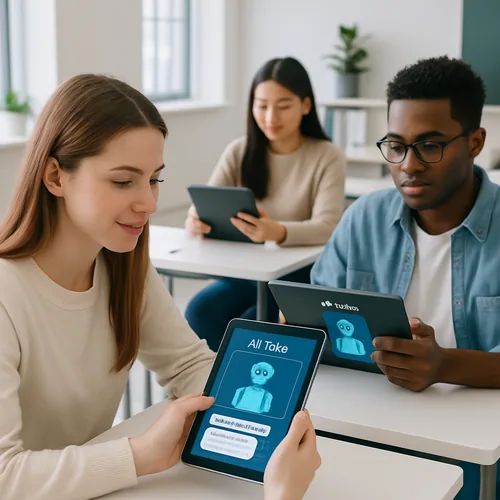
The key to a successful AI tutor lies in its ability to diagnose, prescribe, and validate learning in real-time. Unlike platforms that only offer adaptive content, true AI tutors provide targeted feedback and assessments that lead to measurable learning gains. Competitors like Carnegie Learning's MATHia and Khanmigo use different architectures to achieve these outcomes.
Architectures and Their Enablement
Different models cater to various needs. For example, Carnegie Learning's MATHia uses domain models for math, while Khanmigo offers conversational tutoring with AI-driven feedback. LeapSkill AI coach provides role-based skill pathways for corporate upskilling.
Essential Instructional Features
| Feature | Function |
|---|---|
| Diagnostic assessment | Identifies misconceptions beyond pretest scores |
| Personalized sequencing | Uses algorithms to choose activities based on goals |
| Targeted feedback | Adapts to learner error patterns with hints and examples |
| Mastery tracking | Uses competency maps and spaced practice for retention |
| Explainability | Provides reasons for activity suggestions and content sources |
| Teacher workflows | Offers dashboards for real-time involvement and oversight |
| Safety | Includes hallucination filters and factuality checks |

How AI Tutors Personalize Learning
AI tutors use a continuous, signal-driven loop to personalize learning, adjusting what learners practice, how feedback is delivered, and when practice is scheduled. This differentiation is not a single feature but a comprehensive approach to adaptive learning.
Signals and Triggers
| Signal Type | Examples |
|---|---|
| Short signals | Item correctness, response time, help requests |
| Long signals | Mastery trajectories, course progress, manager/teacher ratings |
How Signals Become Instruction
Practical techniques include item response theory, reinforcement learning, and heuristic rules to translate data into learning actions. The key is to balance adaptive practice with nonadaptive modules for a broader learning experience.
Learning Outcomes and Evidence
High-quality AI tutors result in measurable learning gains, particularly for structured, procedural tasks. The effectiveness of these systems depends on their design, domain specificity, and integration with educator workflows.
| Study/System | Impact | Best for | Limitation |
|---|---|---|---|
| ITS Meta-analyses | Effect sizes ~0.4–0.8 | Stepwise problem solving | Short-term, task-specific gains |
| Carnegie Mellon OLI | Moderate to large gains | Supplemental instruction | Requires curriculum alignment |
Use Cases Across Education and Training
AI tutors are adaptable across K-12, higher education, and corporate training environments, each with unique operational goals.
K-12: Differentiated Practice and Teacher Augmentation
AI tutors provide adaptive practice and automated hints, freeing teachers to focus on small group instruction and extending learning into the home environment.
Higher Education: Scalable Office Hours and Lab Tutoring
AI tutors ease bottlenecks in large courses by offering guided practice and coding support, though they should not replace human graders.
Corporate Training: Role-Based Simulations and ROI
AI tutors shorten ramp time for new hires and enable safe rehearsal for soft skills, provided they integrate with manager coaching and on-the-job tasks.
Evaluating and Comparing AI Tutor Vendors
Begin by focusing on outcomes rather than features. Evaluate pedagogical fit, evidence of efficacy, data privacy, integration, and transparency.
| Vendor | Best for | Strength | Limitation |
|---|---|---|---|
| LeapSkill | Corporate coaching | Data-driven pathways | HR integration required |
| Khanmigo | K-12 practice | Integrated content scaffolding | Teacher workflow adoption needed |
| Carnegie Learning MATHia | Math mastery | Strong efficacy record | Narrow scope, higher cost |
Pilot and Implementation Roadmap
Start with a measurement plan to ensure pilots lead to scaling. Define roles, track metrics, and conduct quality checks throughout the pilot phases.
| Phase | Duration | Deliverables |
|---|---|---|
| Discovery & Baseline | 2–4 weeks | Stakeholder interviews, success metrics |
| Setup & Training | 1–2 weeks | SSO/rostering, instructor workshops |
| Pilot Execution | 6–8 weeks | Cohort runs, monitoring |
| Analysis & Decision | 2 weeks | ROI estimate, review |
Ethics, Privacy, and Accessibility
Address privacy, fairness, and accessibility upfront to avoid legal and reputational risks. Implement GDPR compliance, data minimization, and accessibility features.
Near Term Trends and Recommendations
Future trends include multimodal tutors, microcredentialing, explainable pedagogy, and hybrid architectures. Recommendations vary by role, but all emphasize measurable pilots and pedagogical transparency.
Frequently asked questions
The guide says a true AI tutor can diagnose, prescribe, and validate learning in real time, going beyond platforms that only serve adaptive content. Essential instructional features it lists include diagnostic assessment, personalized sequencing, targeted feedback, mastery tracking, explainability, teacher workflows, and safety measures like hallucination filters and factuality checks.
Per the guide, AI tutors run a continuous, signal-driven loop that adjusts what learners practice, how feedback is delivered, and when practice is scheduled. They read short signals (item correctness, response time, help requests) and long signals (mastery trajectories, course progress, manager or teacher ratings) and translate them into instruction using techniques like item response theory and reinforcement learning.
The guide points to intelligent tutoring system meta-analyses with effect sizes around 0.4 to 0.8 for stepwise problem solving, and Carnegie Mellon's OLI showing moderate to large gains for supplemental instruction. It's candid about limits: gains are often short-term and task-specific, and OLI results require curriculum alignment. Effectiveness depends on design, domain specificity, and educator integration.
The guide draws this line clearly: adaptive content platforms only adjust what they show you, whereas true AI tutors also provide targeted feedback and assessments that lead to measurable learning gains. The tutor diagnoses misconceptions, prescribes activities, and validates mastery rather than simply reordering material.
The guide notes different systems use different architectures: Carnegie Learning's MATHia uses domain models for math, Khanmigo offers conversational tutoring with AI-driven feedback, and the LeapSkill AI coach (leapskill.ai) provides role-based skill pathways for corporate upskilling. So LeapSkill is positioned for workplace, role-specific learning rather than K-12 math drills.
The guide includes a vendor evaluation checklist and emphasizes instructional features like diagnostic assessment, personalized sequencing, targeted feedback, mastery tracking, explainability (reasons for suggestions and content sources), teacher dashboards, and safety measures such as hallucination filters and factuality checks. It also weighs the trade-off that richer student models improve adaptivity but raise data and privacy demands.
The guide lists explainability as an essential feature: a strong AI tutor provides reasons for its activity suggestions and cites content sources. This builds trust, lets educators verify why a learner was routed a certain way, and supports oversight. It pairs with safety features like factuality checks to keep recommendations grounded and accountable.
The guide says AI tutors adapt across K-12, higher education, and corporate training, each with distinct operational goals. In K-12 the focus is differentiated practice and teacher augmentation. The same diagnose-prescribe-validate loop applies, but goals shift, for example role-based corporate upskilling versus classroom support, which is why architecture and feature priorities differ by setting.
Per the guide, short signals are immediate data points like item correctness, response time, and help requests, while long signals include mastery trajectories, course progress, and manager or teacher ratings. AI tutors combine both, using methods like item response theory, reinforcement learning, and heuristic rules, to decide what to practice next and when.
The guide names hallucination filters and factuality checks as essential safety features, since language-model-based tutors can otherwise present inaccurate information confidently. It also flags that richer student models raise privacy concerns alongside the complexity they add. The dedicated ethics, privacy, and accessibility section signals these are core evaluation criteria, not extras.
Further Reading
- AI in Education: Personalized Learning through Intelligent Tutors
- Effective Personalized AI Tutors Via LLM-Guided Reinforcement Learning
- Personalized Learning with AI Tutors: Assessing and Advancing Epistemic Trustworthiness
Ready to Build with AI?
Contact Silicon Prime — we help companies design and ship production-grade AI products.
Comments